

The argument usually gets framed as a replacement question: is generated video going to replace UGC creators, yes or no. That framing produces heat and no decisions. Both are the same format, creator-style vertical video, arriving in the same feeds, judged by the same three-second reflex. The real question is narrower and more useful: for the specific video you need next, which production method fits the job?
That question has an answer, and it is different for different jobs. Here is the honest split.
What a filmed creator still does better
A real person on camera brings things a model cannot supply, and pretending otherwise wastes money in the other direction.
- Lived use. A creator who has actually run in the shoes or cooked with the pan can improvise the small, specific observation that no script contains, and viewers can tell.
- Testimony. When the video’s entire claim is “I tried this and it worked”, the value is that a real, findable person staked their name on it. A synthetic presenter cannot testify, and passing one off as a customer is the kind of move the labelling rules exist to punish.
- Physical demonstration. Texture, fit, weight, taste. If the product’s case is made by hands interacting with it, film the hands.
- An audience. A creator with a following brings distribution as well as content, and a whitelisted post from their account carries a credibility their footage alone does not.
If the next video you need is a founder story, a demo of something tactile, or proof that a human being vouches for you, brief a human being.
Where generation wins
Generation changes the economics of everything around that core, and the economics are most of the job.
- Speed. A brief to a creator is weeks of finding, negotiating, shipping and waiting. A generated video is minutes from prompt to finished cut.
- Volume. Testing ten angles means ten videos. With a creator that is a campaign; with generation it is an afternoon.
- Revision. Changing one line in a filmed video is a reshoot. Changing it in a generated one is changing one line in the studio.
- Coverage. Plenty of products have no natural creator supply at all: industrial tools, B2B software, unglamorous categories where nobody is queueing to post. Generation does not care whether a niche is fashionable.
- Consistency. The same message across markets, languages and variants, without re-briefing anyone.
None of these is about the single best video. All of them are about how many honest attempts you can afford, which is the quantity short-form actually rewards.
The cost math, honestly
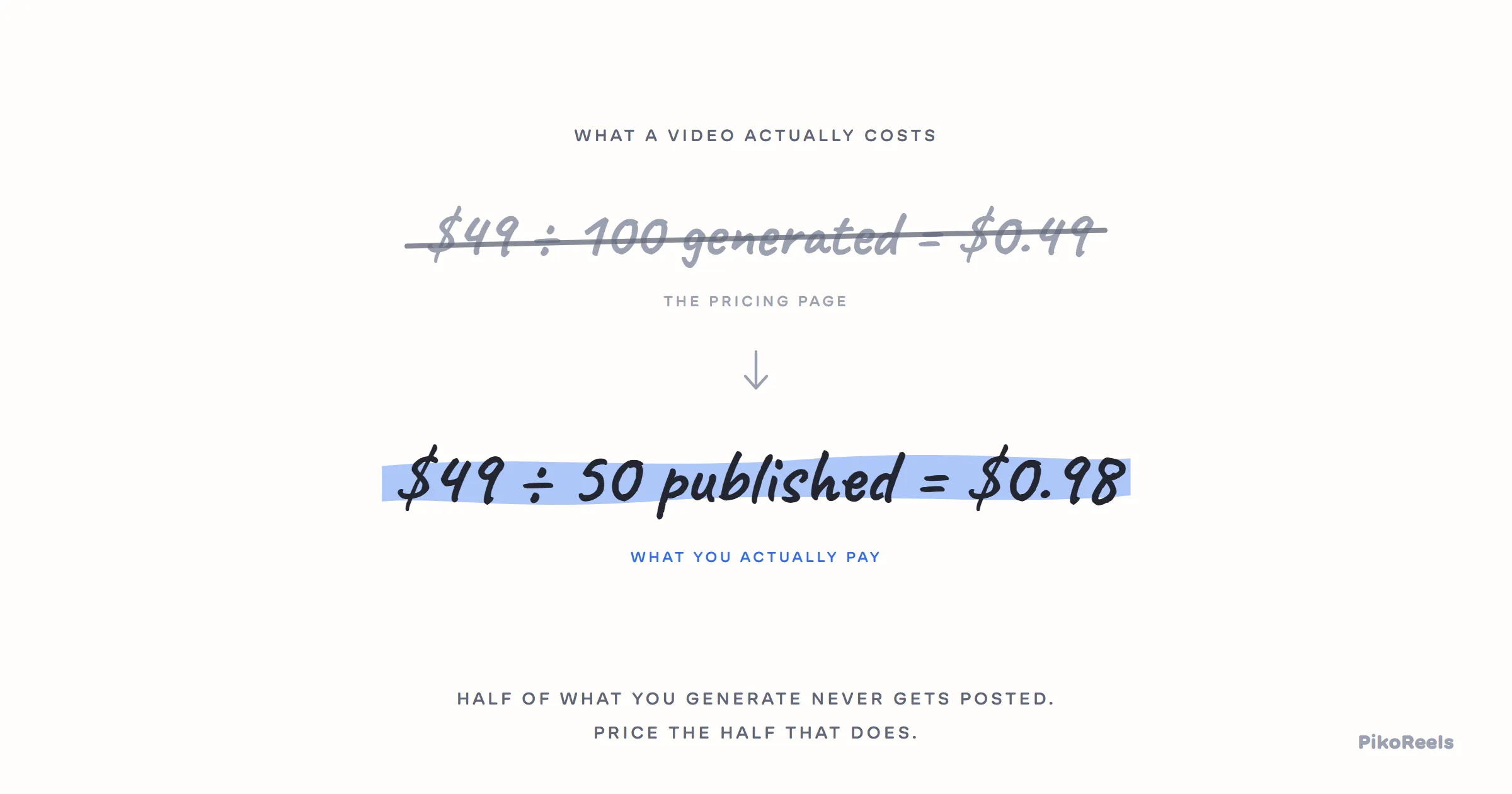
A creator video costs the fee, the seeded product, the shipping, the briefing time and the weeks of waiting, and it typically buys you a small number of videos with usage rights that expire. A generated video costs a slice of a subscription and a few minutes. Neither number means much on its own; the comparison only becomes real when you divide by what you actually publish. The UGC cost calculator puts the two side by side for your own numbers, and how these tools meter and bill covers the subscription half in detail.
Use generation to find out what to say. Use a creator to say the one thing you have proved.
The division that falls out of the math is the strategy: generation is cheap enough to search with, and a creator is credible enough to be worth pointing at a message once you know it lands.
A split that works
In practice the two are not competitors, they are stages. Run the wide search with generated video: hooks, angles, objections, formats, posted on a steady cadence and read by retention. Then take the angle that survived and give it to a filmed creator as the brief, for the flagship version that carries a face, a name and an audience. The creator video gets better because the guesswork was done before the shoot, and the generated pipeline gets better because a real person’s delivery feeds the next round of scripts.
Whichever mix you land on, compare tools on their published numbers rather than their demos; the comparison pages are written from each rival’s own pricing and dated. The replacement debate can keep running without you. The job is just to match the next video to the method that makes it best.