

The hardest question in e-commerce video is supposed to be “what should we make?”, and for most stores it is the wrong question. If you have a product page that converts at all, the material already exists: the claims are in your bullets, the objections are in your reviews, the questions are in your FAQ, and the proof is in your gallery. What a store lacks is not content. It is a way to turn content it already wrote into thirty vertical videos without hiring a team.
That is the specific gap AI UGC closes, and it is why the format fits e-commerce better than almost any other category.
The raw material is already written
Read your own product page the way a producer would and it decomposes into briefs:
- The feature bullets are claims. Each one is a video that demonstrates it.
- The reviews are a map of desire and doubt, in the customer’s own vocabulary. The five-star ones tell you which benefit to lead with; the three-star ones hand you the objections worth answering on camera.
- The FAQ is a script pile. Every question a buyer asked before purchasing is a hook another buyer will stop for.
- The photo gallery is your before-and-after inventory, and the size chart, the materials note and the care instructions are all the boring specifics that read as evidence in a feed full of adjectives.
One decent product page, read this way, briefs a month of videos before anyone has an idea.
Four formats that sell products
The shapes that move product are the ones that already worked in filmed UGC, matched to what the page gives you. The unboxing, because the payoff is built into the format and the gallery tells you which reveal moment to build toward. The objection answered, taking the sharpest complaint in your three-star reviews and meeting it head on, which is the highest-intent format and the one most stores are afraid of. The three-things list, which survives being swiped early, so even a lost viewer takes one claim with them. And the before state, wherever your product changes something visible in under a second.
Where the scripts come from
The best ad language for a product is usually sitting in its own reviews. Customers write hooks professionals do not: specific, casual, slightly wrong in the way real speech is wrong. Opening a video with the exact sentence a reviewer wrote, then answering it, borrows the credibility of how people actually talk about the product.
Borrow the words, not the person. A generated presenter can voice a real question from your reviews or demonstrate the product; what it must never do is claim to be the customer who wrote it. A fabricated testimonial is the one use of this format that every platform’s rules treat as deception rather than production, and it torches the exact trust the review language was borrowed for.
The best ad copy for a product is usually sitting in its own reviews. The job is to say it out loud before a competitor does.
The loop that finds the winner
E-commerce is where the volume argument stops being abstract, because there is a purchase at the end of the funnel to settle arguments. Generate several versions per brief, a deck at a time, post them on a steady cadence, and read retention with the hook rate calculator the way the hooks playbook describes. Most versions will be unremarkable, which is fine and is the point: the process exists to find the one angle that holds attention, and then to spend behind that one with confidence instead of hope.
Publishing without a content team
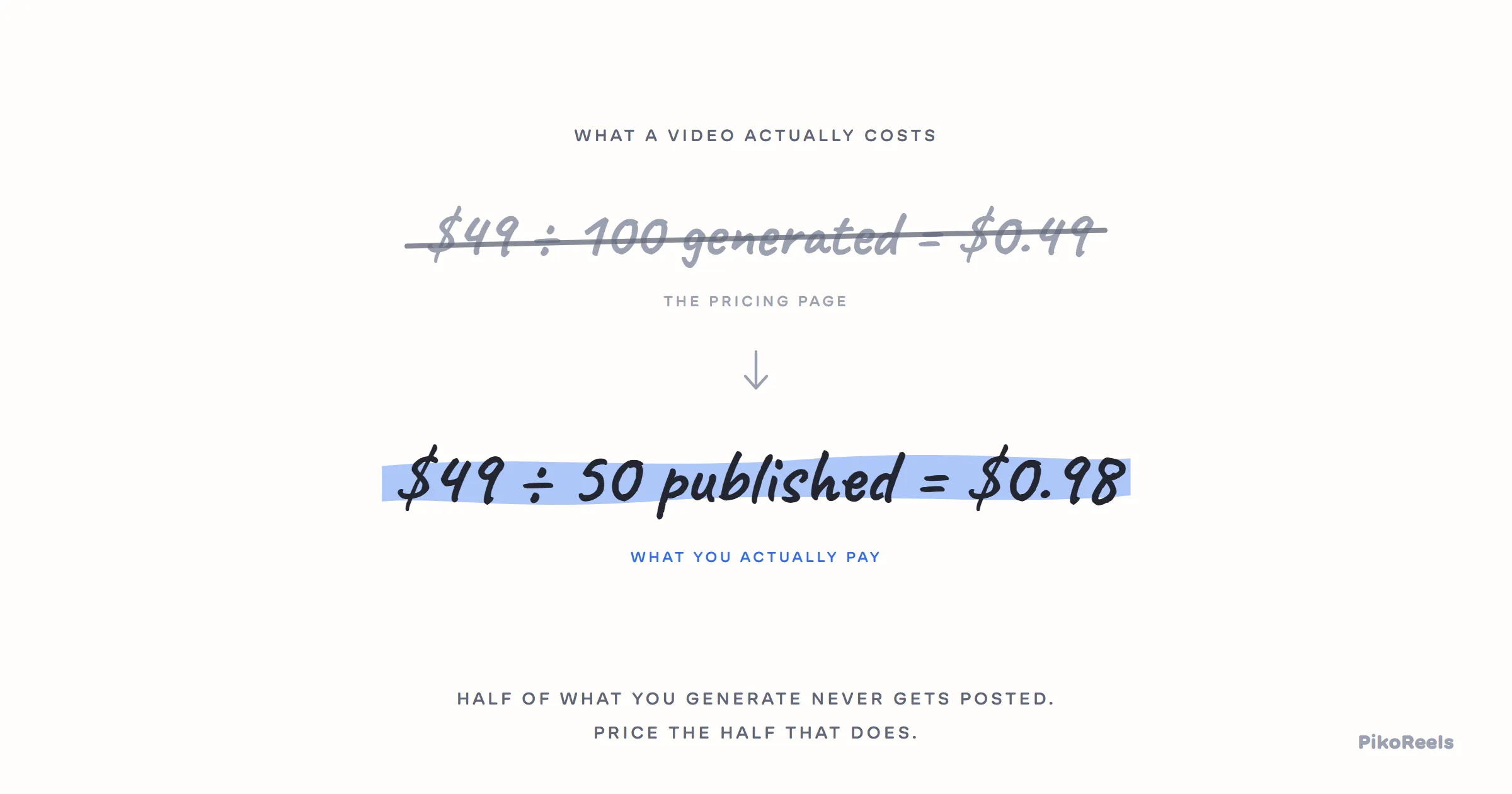
The half that kills store video programs is not creation, it is operations: cutting to 9:16, writing captions, and remembering to post at a sensible hour across TikTok, Instagram Reels and YouTube Shorts while also running a store. That part is mechanical, which means it can be scheduled once and left to run. If you are weighing the cost against briefing filmed creators, the UGC cost calculator puts the two side by side, and what these tools cost explains the billing models before a sticker price can mislead you.
The product page took you weeks to get right. The month of reels is the same argument, restated for the feed.